Learn, Think, Write

Organizing myself online

  • Older Posts
  • Categories
  • About
  • Favorite Books

Thinking About

April 20, 2023

Uncertainty tolerance.

I was surprised to see my anxiety levels elevated lately, but I’m coming to terms with it. We are considering moving- either to another house in Fredericksburg or into a retirement community in another town. All this is happening right before we plan a long trip to Rhode Island, my childhood home.

Everything has seemed out of order these days- my sleep, my gut, and my mood have all tanked. When I listened to this podcast at 4am when I couldn’t sleep, I realized my uncertainty tolerance had disappeared. I usually release feelings of control. After all, there is little we can do about, well, most things. But the past two weeks have found me trying to manage stress like this;

  • trying to guess how healthy I will be in ten years
  • structuring my eating on the various books and plans I’ve read about to find the perfect solution
  • reading the MLS for homes at least 5 times a day, “just in case” I miss a house going on the market
  • listening to too many podcasts about how to live a healthy life as an older person
  • buying one more sleep solution (a pill with gaba and juju something or other) to solve my sleep issues

Yes, you see my attempt to control those issues that are causing me stress– are actually causing me more stress. :)

Elissa Epel, author of The Stress Prescription, says “people who tend to be high on intolerance of uncertainty experience experience more stress and anxiety.” A better solution is getting more comfortable with uncertainly and getting used to being “ok” with that, she says.

My intention today is to try to let go, think about what I can control and what I can’t. I’ve let my meditation practice slip lately or I pretend that taking a long walk is all I need. That’s part of it, but I want to be more intentional about my practice.

“Things don’t really get solved. They come together and they fall apart. Then they come together again and fall apart again. It’s just like that. The healing comes from letting there be room for all of this to happen: room for grief, for relief, for misery, for joy.”

Pema Chodron

Filed Under: thinkingabout

Now What

March 31, 2023

Poetry, rather writing, has framed my life as long as I can remember.

As a ten-year-old, I wandered around the neighborhood trying to “sell” my hand-scratched newspapers. Though I never kept a diary or journal regularly, I found myself turning to writing when I needed to figure out what I was thinking. Going through a divorce meant writing my way through it. And then when life became complicated and painful, I turned to poetry.

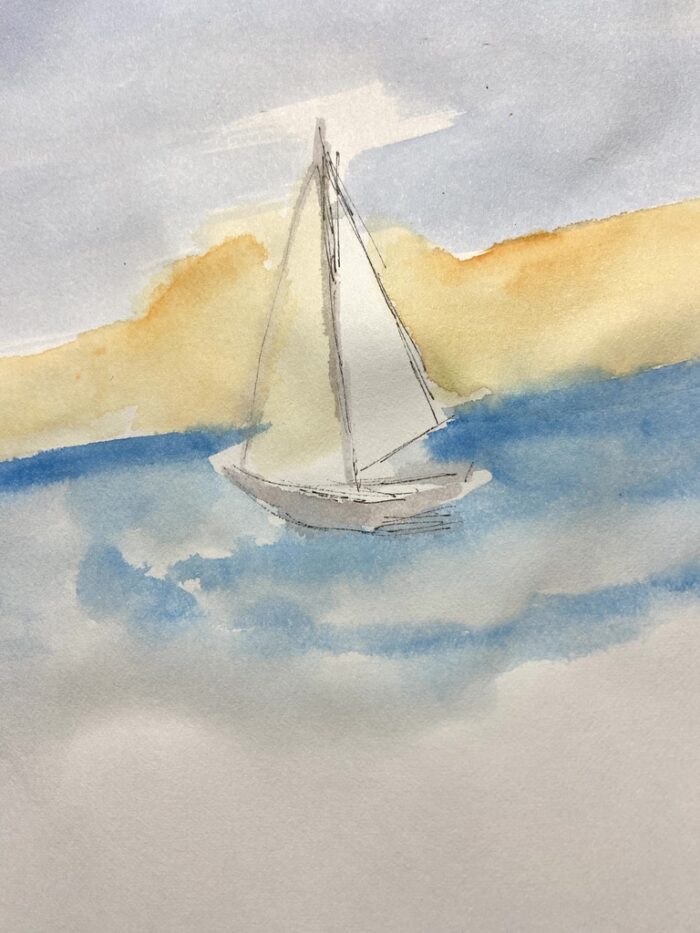
Having just completed a meaningful poetry/photography project with friend Donna Hopkins about family and aging, I find myself without a plan for my writing. That means putting pen to paper in whatever way feels good– like sketching! I’ve learned to let go of perfection- like the yellow sky in the sketch here that drips into where the water should be. Or the published poetry that should be in a different form. It’s the process, I’ve learned, that matters.

Wherever I am in my life (and whoever I am), I’ve discovered I need to create. I don’t like to cook or garden, but give me a pen and I’m content.

Czesław Miłosz once wrote:

The purpose of poetry is to remind us
how difficult it is to remain just one person,
for our house is open, there are no keys in the doors, 
and invisible guests come in and out at will


Filed Under: artandwriting, creativity, thinkingaboutTagged: watercolor, writing

An Ending and a Beginning

March 12, 2023

When I browse the archives of my posts, I discover the words “starting over” many times. Now, here I am at the end of something again. My project with friend and photographer Donna Hopkins has come to a natural conclusion, a year of photo/poetry collaboration and much more. Her explanation shares all you need to know about our project, so please visit her site to see more photos and the focus of the year-long partnership.

Donna’s photos provided me with much inspiration to write– about aging, parents, failure, friendship, and life. Her photography perspectives gave me an opportunity to consider different perspectives in my writing. I was finally writing for myself. Our book holds truth, pain, joy, and vulnerability of who we are, of what these moments at this point in our lives reveal.

This bittersweet conclusion won’t end our friendship, though. In fact, I am hoping we will leap into another creative adventure before long. We share much in common, and working with Donna is a joy. She brings out the best in me.

So now, another beginning. Creativity connects me to myself, provides a window into who I am.

Let the next project begin!

Time to Think

Houses line my daily walk,
small, some old, a mansion
on the hill, the dog park.

I never veer, so my mind
tucks into itself, stepping
one thought after another.
Bright sun spoofs me
with winter’s bitter breath.

I am the stranger
walking by your house,
waiting for spring flowers,
a revelation, a peek of yellow 
or perhaps radiant rose.

Peppers in my kitchen grow
under lights, lush leafy green,
higher each day. A sign
of what has been planted
and what is to come.


Filed Under: artandwriting, thinkingaboutTagged: photoproject, poetry

Whole Brain Living

February 6, 2023

I’ve been following Jill Bolte Taylor since she had her stoke. Imagine at the age of 37, losing your capacity to talk, read, write, or recall the history of your life. But she recovered. And she has studied her healing every since.

Today I decided to listen to a podcast as I took my afternoon walk. I flipped my finger on my phone until it landed on Ten Percent Happier, a podcast I rarely miss. However, I hadn’t heard this one with Jill Bolte Taylor. Wow, I was so focused, I nearly tripped over a tree root.

Here’s a brief summary I’ve copied from her website. (I’ve now bought the book on Audible!)

She says: Our Four Characters take turns running our life. Our Character 1 goes to work, our Character 2 wants to make sure we are safe, our Character 3 gets us outside to play in the sun, and our Character 4 comes out when we feel grateful and connected to others.

Call a BRAIN Huddle, she says, when we want to make sure we are being who we want to be.

B for Breathe: Our breath is always with us.

R for Recognize: Once you bring your mind into the present moment, recognize which of your Four Characters you were exhibiting when you called the BRAIN Huddle.

A for Appreciate: Regardless of which character called the Huddle, appreciate the fact that you have four different characters and ask them all to participate in the Huddle.
(This is particularly important when our fear-based Character 2 has been triggered and could use some support.)

I for Inquire: Invite all Four Characters into the huddle, so they can collectively voice their opinions and consciously strategize your next move.

N for Navigate: Life is made up of sequential moments and once our Four Characters are all in the BRAIN Huddle, we then have the power to choose which character we would like to have come out next. This is how we own our power, and no one can take our power away from us. With all of our Four Characters gathered in the BRAIN Huddle, we can choose moment by moment who and how we want to be.

I have to admit, this brings out my Character #2 in full force and makes me want to take a nap! But her explanation of it on the podcast has given me a reason to learn more.

Practice this 20 times a day, she says. It takes an instant “pause.” Become familiar with the characters. It’s like learning a new language.

I do love learning.


Filed Under: anxiety, brain, thinkingabout

52

February 2, 2023

my beach, playing with my Canon camera

I hadn’t been keeping track. But my friend, Donna, told me I’d written 52 poems for our project.

Writing, talking with Donna, planning, editing…all of this has been a joy. But I hadn’t really thought about the heft of this project until she mentioned the number. And that means, she, of course, has taken 52 photographs. The idea seemed simple: she’d send me a photo and I’d use it for inspiration to write a poem.

We didn’t plan for this to be so huge. We didn’t even envision it. We hadn’t realized how much this would end up being about those very things that drew us together in the first place– a shared experience with grief, complicated relationships with mothers, and aging. Our conversations drove this naturally, and it came to an obvious conclusion. A year. A season in our lives.

Poetry can be revealing, and for me so healing. Over the course of the year, as my poetry collection grew, so did my recognition of buried emotions. Writing about them helped me process feelings and come to terms with them.

Another challenge– imposter syndrome–came in like a storm. Even now I read some of my work with an overly critical eye, wondering who the heck I think I am to be writing poetry. This syndrome, first identified by Ruchika TulshyanJodi-Ann Burey, is one many women face.

Enter what’s known as imposter syndrome, which was originally coined by psychologists Pauline Clance and Suzanne Imes in their study of professional women in a clinical setting. For people with imposter syndrome, self-doubt, insecurity, and perpetual trepidation that their inadequacies will be discovered is a way of being in the workplace. Any successes and accomplishments can trigger anxiety. Women and ethnic minorities are often the hardest hit because hierarchical and masculine cultures can contribute to imposter distress.

I have learned to speak gently to myself, calm myself down. In a few hours, I am usually able to realize where this is coming from. People pleasing tendencies manifest in many ways. Also, I know I am writing for me, and this writing has been healing.

When we write about psychologically upsetting experiences, we actively confront the event and the emotions it has engendered. We are able to give perspective to the experience and its relation to the rest of our lives by opening up (… and) constructing an understandable narrative of what occurred. In this way, expressive writing is much like excising a wound – rather than obsessively ruminating about the event in a manner that yields no answers, thus allowing the painful experience to fester and possibly lead to mental health problems, expressive writing allows us to cognitively confront, process, and heal from the pain.

https://www.artandhealing.org/evidence-of-the-healing-power-of-expressive-writing/

We will be putting the finishing touches on this project over the next month and then sending it to MILK, where they will create a beautiful book for us! I am so grateful to have shared this time with her. We’ve already talked about doing something together in the future. Both Donna and another friend Linda have rekindled my interest in photography. And I’ve signed up for a watercolor class. I don’t know where this will lead, but I am open to possibilities.

“Art is a wound turned into light.” ~ Georges Braque


Filed Under: thinkingabout

  • « Previous Page
  • 1
  • 2
  • 3
  • 4
  • 5
  • …
  • 163
  • Next Page »

Archives

Categories

Theme Design By Studio Mommy · Copyright © 2026